

Last Updated: November 2, 2026
Quick Summary
To start a mindfulness practice, sit comfortably in a quiet spot and focus on your breath for three to five minutes a day. Each time your mind wanders, gently bring it back. Build up to ten or fifteen minutes over four weeks.
- Begin with three to five minutes of practice daily at the same time.
- Choose a quiet, comfortable spot and silence notifications before you start.
- Count each exhale from one to ten, and start over at one if you lose count.
- Increase your session to 10 to 15 minutes by week four.
- Missed days are not failures; simply restart the next day at the same length.
Table of Contents
- What a Mindfulness Practice Actually Involves
- Step 1: Choose a Quiet, Comfortable Place
- Step 2: Set a Realistic Duration and Daily Schedule
- Step 3: Practice a Mindfulness Breathing Exercise
- Mindfulness Exercises for Beginners Who Find Sitting Hard
- Troubleshooting Common Beginner Difficulties
- A Structured First-Month Plan
- Choosing Guided or Self-Guided Practice
- Frequently Asked Questions
What a Mindfulness Practice Actually Involves
Starting a mindfulness practice is simpler than most people expect. Many beginners feel they need special skills or a perfect setup before they begin.
That's the core of it.
This guide walks you through the basics, one step at a time.
Mindfulness works best as a habit, not a one-off event. Short, regular sessions beat long, rare ones. Keep that in mind as we go.
Step 1: Choose a Quiet, Comfortable Place
Pick a spot where you won't be interrupted for the length of your session. It doesn't need to be a special room or a shrine. A corner of a bedroom, a chair by a window, or a cushion in a quiet part of the house will work.
Look for three things:
- Low noise. Turn off the TV and silence your phone. Notifications are the most common reason a short session gets broken.
- Physical comfort. Choose a seat that supports your back without making you sleepy. A firm chair with your feet flat on the floor is usually easier than a soft couch.
- Consistency. Use the same place each day so your body and mind start to recognize it as the practice spot.
That makes focus much harder. Give yourself the easiest possible setup.
What to do when you don't have a quiet place
A perfectly silent room is a nice-to-have, not a requirement. If you live with roommates, share a small apartment, or have young children, waiting for silence can become an excuse to skip practice. A more reliable approach is to practice with mild background noise and treat the noise as part of the exercise.
- Use white noise or a fan. A steady sound masks unpredictable interruptions like traffic or conversation.
- Practice with your eyes open. Softening your gaze toward a wall or the floor reduces the pull of visual distractions and makes it easier to practice in a shared space.
- Choose a lower-traffic time. Early morning before others wake up, or right after a commute, is often quieter than evening.
Set up the space in under two minutes
You do not need a dedicated meditation room, but a few small adjustments make a real difference:
- Put your phone in another room or turn on Do Not Disturb. If you use a timer, set it before you sit down.
- Keep a blanket or sweater nearby. Feeling cold is a common reason people cut sessions short.
- Sit facing a plain wall or a window rather than a cluttered surface or a screen.
- Keep a notebook within reach so you can jot down a thought that feels urgent instead of carrying it through the session.
When the space itself becomes the obstacle
Some people find that a particular room carries stress, such as a home office where they work long hours. If that's the case, rotate your spot. Practicing in a different chair or facing a different direction can break the association between a place and its usual mental state. The goal is a spot that feels neutral or pleasant, not one that is perfectly quiet.
Step 2: Set a Realistic Duration and Daily Schedule
Start small. Three to five minutes a day is enough for the first week.
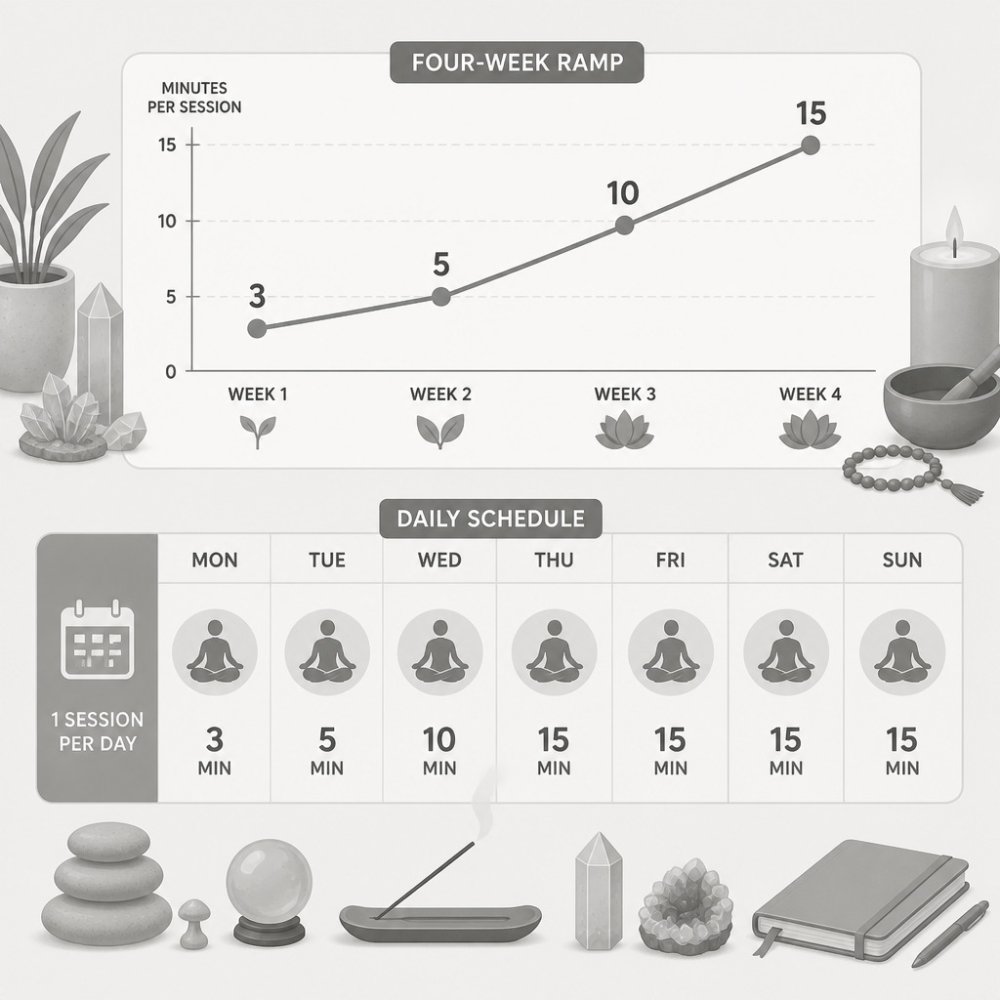
Here is a simple ramp to follow:
- Week 1: 3 to 5 minutes, once a day
- Week 2: 5 minutes, once a day
- Week 3: 7 to 10 minutes, once a day
Pick a fixed time, such as after you brush your teeth in the morning or before dinner.
Use a timer so you don't keep checking the clock. Most phones have a built-in option.
The ramp below shows how to build your session length week by week.
| Week | Daily session length | Focus |
|---|---|---|
| Week 1 | 3 to 5 minutes | Build the habit |
| Week 2 | 5 minutes | Practice daily |
| Week 3 | 7 to 10 minutes | Extend the session |
| Week 4 | 10 to 15 minutes | Settle into a routine |
Step 3: Practice a Mindfulness Breathing Exercise
Breath is the most common anchor for beginners. It is always with you, and it gives your attention something simple to hold.
Sit comfortably, close your eyes or soften your gaze, and notice your natural breathing. Don't change it.
When your mind wanders, which it will, notice where it went and return to the breath. Do this without criticism.
Breath counting for the first week
Breath counting gives your attention a clear task. Count each exhale from one to ten. When you reach ten, start again at one.
If you lose count, or find yourself thinking about dinner, simply start over at one. Losing count is normal. Many people spend most of their first sessions getting back to one, and that is still practice.
Box breathing as an alternative
Box breathing is a structured pattern that many people find calming. Breathe in for four counts, hold for four, breathe out for four, and hold again for four.
Box breathing can feel more active than simply observing the breath. You can also follow a guided breathwork session that walks you through breath awareness without requiring you to sit still.
Mindfulness Exercises for Beginners Who Find Sitting Hard
Sitting still with your eyes closed is not the only way to practice. If you feel restless, sore, or uneasy in that position, you have other options. In fact, many experienced practitioners rotate between seated and movement-based methods because each one trains attention in a slightly different way.
Walking meditation
Walking meditation is the most direct alternative to sitting. You can do it indoors across a room or outdoors along a sidewalk.
- Stand still for a moment and feel your feet on the ground.
- Walk at about half your normal pace.
- Pay attention to one part of each step at a time: the lift of the heel, the swing of the leg, the contact with the ground.
- When your mind wanders, return to the sensation of the next step.
Start with five minutes. Walking meditation is especially useful on days when sitting feels agitated or when your back or hips are uncomfortable.
Fully Present: The Science, Art & Practice by Susan L Smalley →
Standing and eyes-open practice
If closing your eyes makes you drowsy or anxious, keep them open with a soft gaze toward the floor a few feet ahead. Standing practice follows the same structure as seated practice: stand with your feet hip-width apart, let your arms rest at your sides, and follow your breath. Eyes-open practice is also a good fit for shared spaces or for anyone who feels uneasy with eyes closed.
Mindful listening
Sit or stand and listen to the sounds around you for two minutes. Notice each sound without naming or judging it. When you catch yourself labeling a sound as annoying or pleasant, return to the raw sound itself. This is a useful practice for noisy environments because it turns distraction into the object of attention.
Mindful eating
Choose one bite of food and eat it slowly, noticing taste, texture, and temperature. For a more hands-on option, try a tactile mindfulness tool that gives your attention something to hold while you stay seated or stand. Put the fork down between bites. This is one of the easiest ways to practice during an ordinary meal, and it does not require any extra time in your day.
Everyday activities as practice
Formal sessions are only one part of mindfulness. The same attention can be applied to routine tasks, which extends the practice beyond the cushion:
- Washing dishes. Feel the water temperature, the weight of each dish, and the motion of your hands.
- Showering. Notice the sensation of water and the smell of soap instead of rehearsing the day's to-do list.
- Walking to your car or the bus. Use the first two minutes of any walk as a walking practice.
A practical rule is to pick one routine activity per week and treat it as a short practice. Over a month, you will have built several everyday anchors without adding any time to your schedule.
Choosing between methods
There is no single best method. A simple way to decide:
- Restless or agitated? Try walking meditation or box breathing.
- Sleepy? Try standing practice or eyes-open practice.
- Short on time? Use mindful eating or a two-minute listening practice.
You do not have to choose one method forever. Mixing sitting, walking, and breath-based practices keeps the habit fresh and helps you practice in different conditions rather than only when the setup is ideal.
Troubleshooting Common Beginner Difficulties
Almost every beginner runs into the same few problems. Here is how to handle them.
"My mind won't stop racing." This is the most common complaint.
"I fall asleep." Try sitting upright rather than lying down.
"I feel more anxious, not calmer." Some people notice stronger feelings when they slow down. If strong distress continues, talk with a qualified mental health professional (Caring for Your Mental Health).
"I keep skipping days." Missing a day is not a reason to quit.
"I don't feel like I'm doing it right." There is no single right way to feel.
A Structured First-Month Plan
Use this plan to build your habit over four weeks.
Week 1: Build the habit.
- Practice 3 to 5 minutes daily at the same time
- Use breath counting
- Goal: show up every day
Week 2: Deepen focus.
- Practice 5 minutes daily
- Switch between breath counting and simply noticing the breath
- Goal: notice wandering sooner and return faster
Week 3: Extend and vary.
- Practice 7 to 10 minutes daily
- Try one alternative method, such as walking meditation or box breathing
- Goal: keep the habit even when sitting feels harder
Week 4: Settle in.
- Practice 10 to 15 minutes daily
- Choose the method you prefer and stick with it
- Goal: make the practice a routine part of your day
How to measure progress without overpromising
Progress tends to be quiet. You might notice you pause before reacting, or that you recover from distraction more quickly. Track consistency rather than expecting big results. Write one line each day about how the session went. Over a month, patterns show up that a single session would never reveal.
Choosing Guided or Self-Guided Practice
You can practice on your own or with a guide. Each approach has trade-offs.
Self-guided practice works well once you know the basics. It is free, flexible, and always available.
Guided practice uses an instructor or recording to lead you through each step. This helps beginners who want structure, reassurance, or help with specific techniques.
A practical approach is to start with guided sessions during your first two weeks, then move to self-guided practice once the routine feels natural. For a deeper look at the subject, you can explore How to Meditate by Lawrence LeShan at https://www.spirituallyrooted.com/products/beat-the-blues-before-they-beat, or Fully Present by Susan L Smalley at https://www.spirituallyrooted.com/products/ayurvedic-herbs.


Whichever path you choose, the key is consistency.
Frequently Asked Questions
How do I start a mindfulness practice as a beginner?
Start with a single short session, about three to five minutes, in a quiet spot where you won't be interrupted. Sit comfortably, close your eyes or soften your gaze, and focus on the sensation of breathing at your nostrils or chest. When your attention drifts, notice where it went and gently bring it back to the breath. Repeat this daily at the same time so the practice becomes a routine, and increase the length slowly only once the short version feels manageable.
How long should I practice mindfulness each day?
Most beginners do well starting with five minutes a day and increasing gradually to ten or fifteen minutes over several weeks. Consistency matters more than length, so a short daily session usually builds the habit better than an occasional long one. If you miss a day, simply return the next day without trying to make up the time. The right duration is the one you can keep up over time.
What is the easiest mindfulness exercise to start with?
Breath awareness is the simplest starting point. Sit comfortably and pay attention to the natural rhythm of your breathing. Breath counting, where you count each exhale from one to ten and start over when you lose track, adds a gentle anchor for attention. Both exercises require no equipment and can be done in any quiet place, which makes them a practical first step for most people.
What should I do when my mind wanders during mindfulness practice?
Wandering attention is normal and is not a failure. Each time you notice your mind has drifted, that moment of noticing is the practice itself. Label the distraction briefly, such as thinking or planning, then return your attention to the breath. Many beginners find that counting breaths or using a soft phrase helps them come back more easily. Expect to repeat this many times in every session.


